

I asked my subscribers one question:
“What’s your biggest challenge with AI- for investing today?”
55% said the same thing: fear of hallucinations.
Here’s the truth:
You can’t eliminate hallucinations completely.
But you can reduce them by 99,99%.
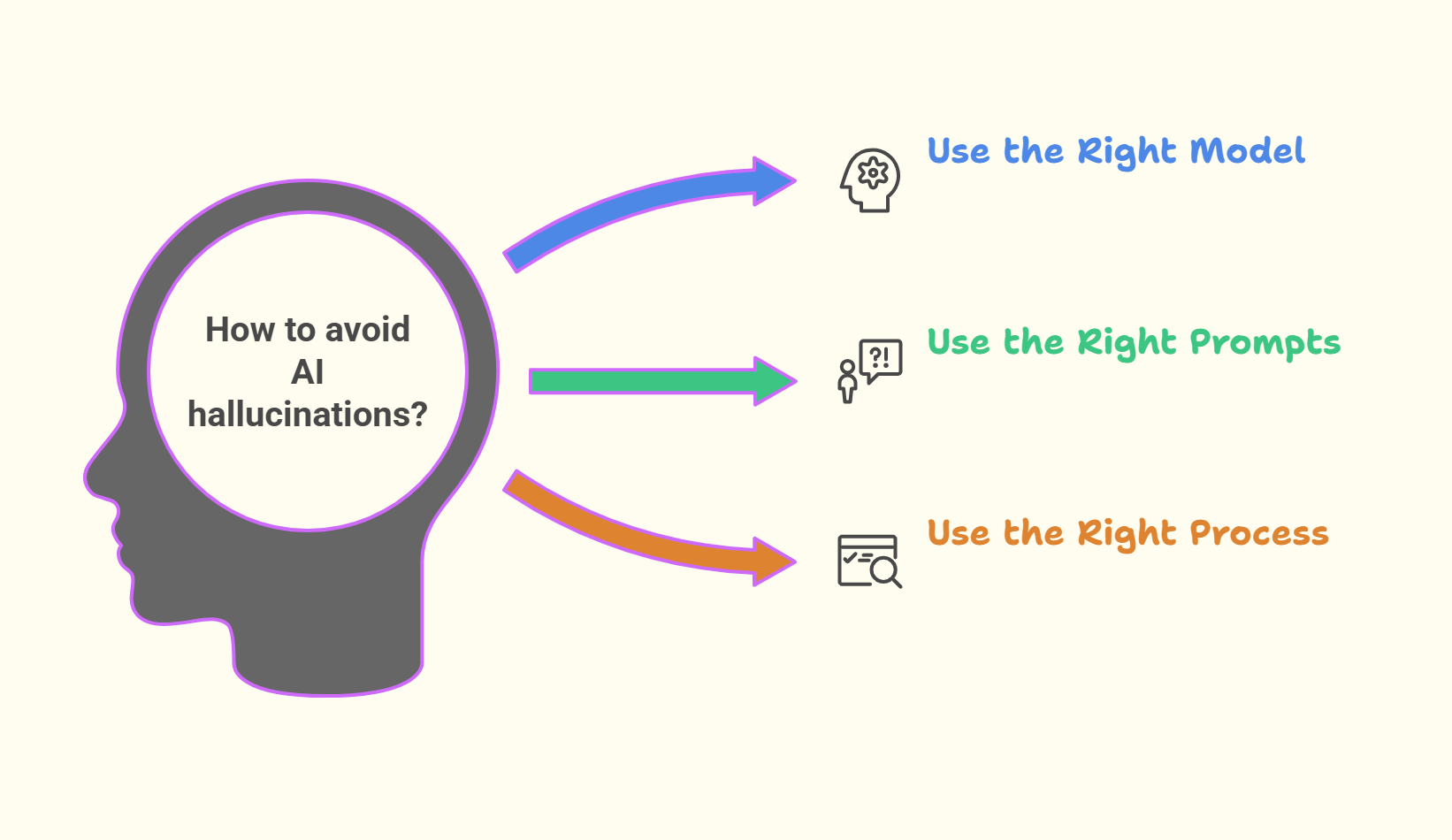
Today, I’ll show you the 3 secrets to have no hallucination in you AI investing process:
Secret #1: Use the Right Model (This alone cuts hallucinations by 70%)
Secret #2: Use the Right Prompts (This constrains what AI can invent)
Secret #3: Use the Right Process (This catches what slips through)

What AI Actually Does (And Why It Hallucinates)
Ideally, AI would work like this:
It checks the annual report
It thinks like an analyst
It runs calculations in the background…
Unfortunately, that’s not what’s happening. Like… not even close.
The real mechanism (simple version)
At its core, an LLM does one thing:
It predicts the next word.
Then the next.
Then the next.
Word by word.
Token by token.
That’s it.
Example: Ask AI about Apple’s pricing power
You type: “Explain Apple’s pricing power”
The LLM does NOT:
Open Apple’s 10-K
Check margins
Verify anything
Instead, it asks internally:
“Given everything I’ve learned about how humans write about businesses, what usually comes next?”
Common patterns it’s seen:
“brand strength”
“ecosystem lock-in”
“switching costs”
“customer loyalty”
So it generates: “Apple has strong pricing power because its brand and ecosystem lock customers in…”
That’s true and it sounds like analysis.
But mechanically, it’s pattern completion, not verification.
And AI writes so well, it’s always very convincing
Where hallucinations come from
Now you ask: “What was Apple’s ROIC in 2013?”
The model isn’t confident about the exact number.
It faces a choice:
Stop and say “I don’t know”
Generate a plausible-looking number
Often, it does the second.
Not to lie.
It just refuses to say ‘I don’t know.’ Like a lot of people we know
This is what we call hallucination:
Confident text that is not grounded in reality.
For investors, that’s dangerous.
Now here’s the good news:
AI isn’t useless.
You just need to know the 3 secrets that make hallucinations disappear.
Let’s start with the biggest one.
Secret #1: Use the Right Model
This is the single biggest lever.
Most people use AI in “chat mode” the default setting.
And that’s where 70% of hallucinations come from.
There are different ways to use AI.
Each one has a different impact on hallucinations.
Most people stay at Level 1 :
Level 1: Chat Mode (No Sources)
This is the default mode.
And the most dangerous.
How it works:
You type: “Explain Microsoft’s cloud growth drivers”
The AI immediately generates text based on:
Language patterns about “cloud growth”
Common narratives about Microsoft
What “usually comes next” in this type of writing
What it does NOT do:
Read Microsoft’s 10-K
Check earnings transcripts
Verify any facts
Result:
You get a plausible explanation that may be completely wrong.
Hallucination risk: High
Level 2: Chat Mode WITH Sources (You Upload Files)
This is better but still limited.
How it works:
You upload Microsoft’s 10-K and ask:
“Based on this report, explain why cloud revenue grew 25%”
Now the AI:
Ingests the document in chunks
Retrieves passages it judges relevant
Generates an answer conditioned on those retrieved passages
Important:
It does NOT read the entire document line by line.
It works on retrieved sections, not full coverage.
What improves:
The answer is guided by the source material, but not strictly limited to it
Guessing is reduced
Hallucinations are less frequent
The model can say “not mentioned” if information isn’t retrieved
What’s still a problem:
The model only reasons over documents and passages it actually retrieves
If a key section is missed, the analysis can be incomplete
The system may still:
Miss footnotes or edge cases
Misinterpret accounting language
Over-generalize from partial context
Hallucination risk: Medium
Level 3: Deep Research Mode (The Game-Changer)
This is the mode serious investors should use.
Deep Research is not just a button you click.
It’s a research agent that uses an LLM.
The simple way to think about it:
LLM → writes text
Deep Research → decides what to look for, finds it, then asks the LLM to explain
Deep Research = LLM + search + reading + planning + synthesis
It is not a smarter LLM.
It is an LLM coordinating other systems before it starts writing.