

Every great disruption begins long before the earnings miss.
Kodak controlled 90% of U.S. film and 85% of cameras.
In 1996, Kodak generated $16 billion in revenue.
Gross margins on film were near 70%, closer to Hermès than to a typical manufacturing business.
Because every photo required another roll.
Every roll required processing.
To compete, you needed factories, chemicals, labs, and global scale.
Few companies could replicate that system.
Then digital arrived:
By 2011, Kodak’s revenue was down to $6 billion.
In 2012, it filed for bankruptcy.
But the desire to capture moments didn’t shrink !
In 2000, the world took 85 billion photos a year. By 2010, that number had surged past 380 billion.
Demand grew.
But the profit pool migrated to a different part of the value chain.
That’s disruption.
Not falling demand.
Shifting economics.
AI may be creating similar shifts today.
If you invest for the long term, the question isn’t:
“Will this company use AI?”
It’s:
“will AI change the economics of this busineess?”
In this article, I'll show you a simple 3-step framework to answer that clearly:
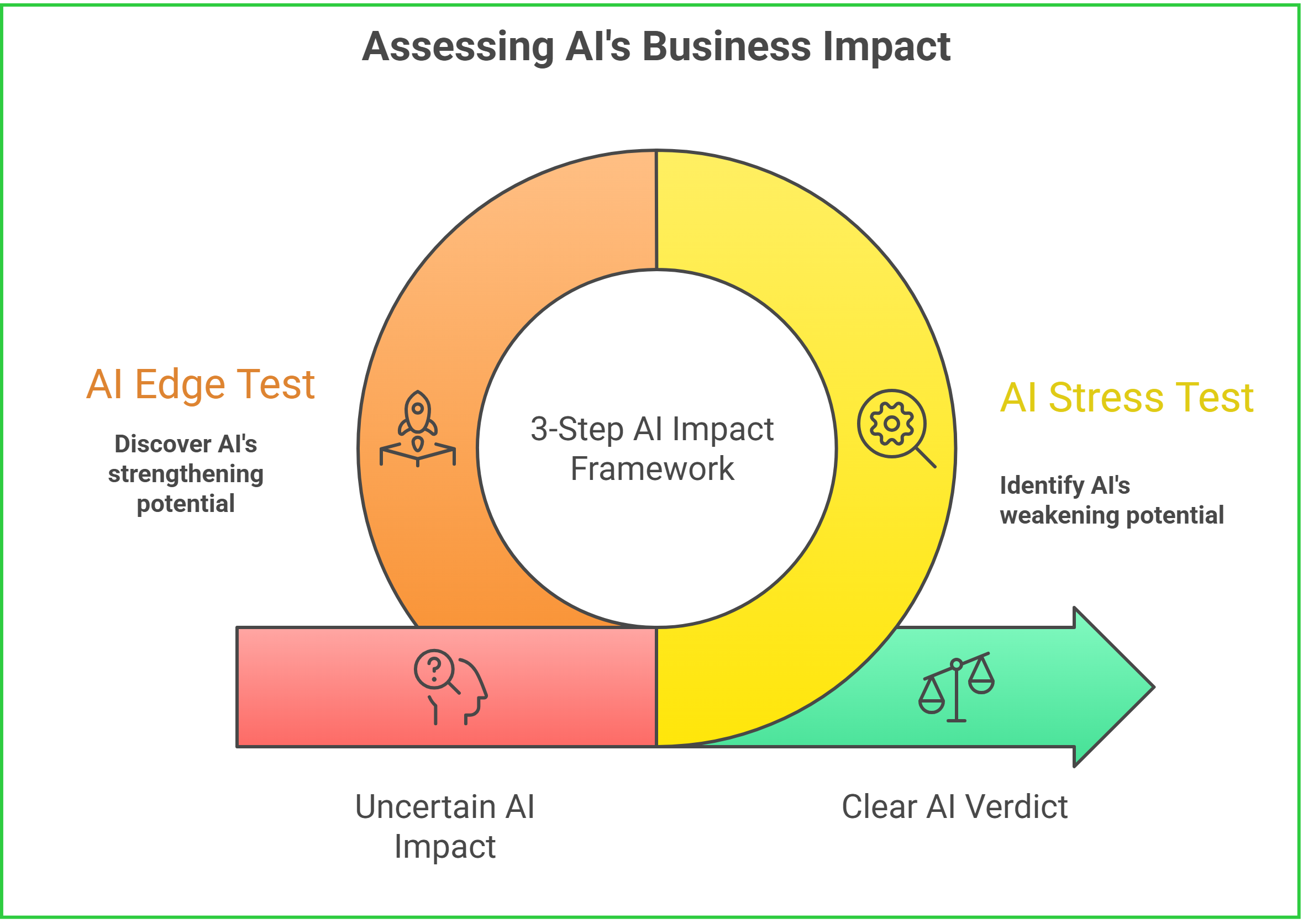
The 3-Step AI Impact Framework
Here’s how it breaks down.
Step 1: The AI Stress Test How could AI permanently weaken this business?
Step 2: The AI Edge Test How could AI permanently strengthen this business?
Step 3: The Verdict On balance, does AI help or hurt?
Three steps. Each builds on the last.
Let me walk you through each one.
Step 1: The AI Stress Test
Start with the downside.
How could AI permanently weaken this business?
Run one Deep Research prompt to build an AI bear case.
Question flow:
What protected this business before AI?
(Moat. Scarce asset. Switching costs. Margin structure.)Does AI directly weaken that protection?
What structural consequences follow?
New entrants?
Bargaining power shift?
Profit pool migration?
What specific bear scenarios emerge?
How to run it
Open Gemini (or your preferred LLM) in Deep Research mode
Replace [COMPANY] with your target
Launch the run
Wait 5–8 minutes
During those 5–8 minutes, Deep Research works like a real analyst:
It searches live sources (filings, transcripts, industry reports, credible publications)
Reads full documents ( 100+ )
Cross-references data across multiple sources
Then writes a long-form, evidence-backed report following the exact prompt framework
The prompt to use:
ROLE

You are a senior equity analyst tasked with identifying how AI could structurally weaken this company’s long-term business model.

COMPANY

[Insert COMPANY]

OBJECTIVE

Identify structural scenarios through which AI could weaken or invalidate this company’s economic engine.

Focus only on downside structural risk.

Assess whether AI could:

Undermine the core competitive advantage

Reduce demand for the product or service

Weaken pricing power

Increase structural cost intensity

Compress sustainable margins

Lower long-term return on capital

Replace the company’s core function entirely

Trace the economic sequence clearly:

AI change → loss of advantage → revenue weakness → margin pressure → lower long-term returns

Mechanism-driven analysis only.
No feature descriptions.
No mitigation strategies.

EVIDENCE STANDARD

Use :

officiel filings

Earnings transcripts

Official company disclosures

Regulator publications

Recognized institutional research


1) EXECUTIVE SUMMARY (Start Here)

Provide 8–10 concise bullets including:

Core breakdown thesis (1 sentence)

Most exposed competitive advantage

Main revenue vulnerability

Primary margin risk

Replacement risk (Yes / No / Limited)

Probability of structural impairment (Low / Medium / High)

Expected time horizon (Short / Medium / Long)

Then summarize:

The most credible scenario

Whether early signs are already visible

Or whether risk remains purely hypothetical

Keep it direct and analytical.

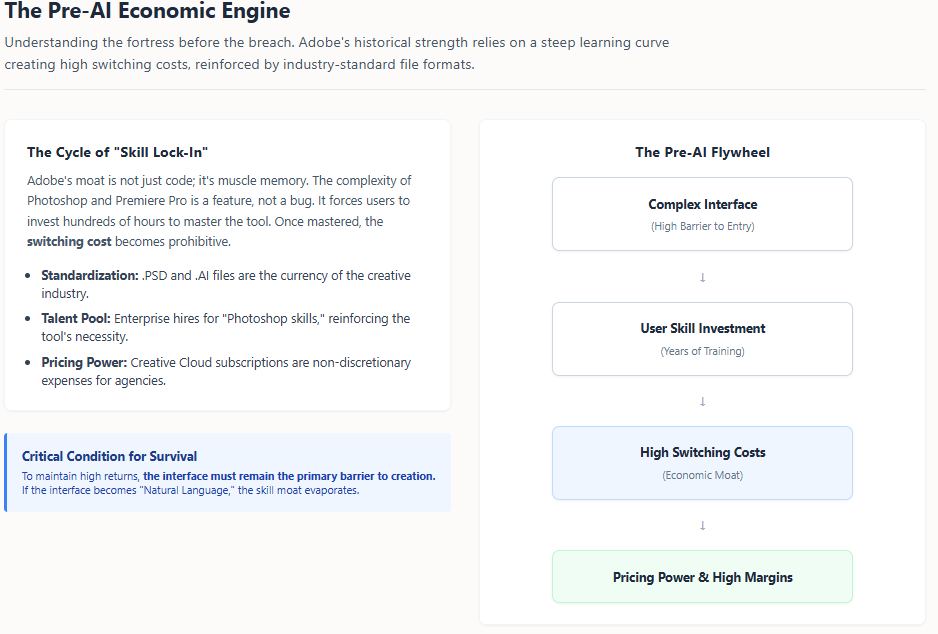
2) PRE-AI ECONOMIC ENGINE

Explain clearly:

What makes this business strong today

Why customers pay premium pricing

Where profits concentrate

Why it has historically earned high returns

End with:

Which single condition must remain true for this business to continue earning high returns?

3) FIRST-ORDER AI EFFECTS (Direct Impact)

Assess whether AI:

Reduces the need for the product

Automates the scarce skill behind it

Makes alternatives “good enough”

Expands supply faster than demand

Introduces new structural cost burdens

Key question:

Does AI weaken the basic economic reason this product exists?

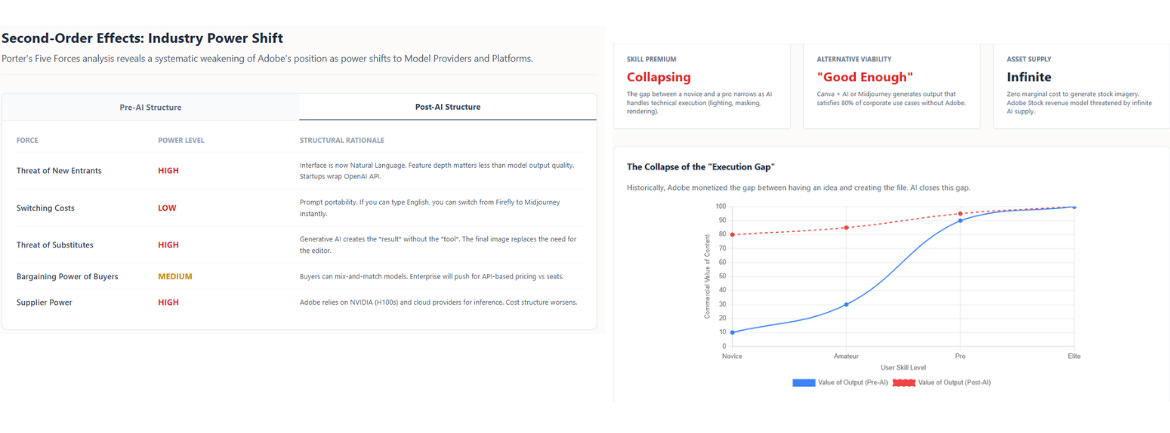
4) SECOND-ORDER AI EFFECTS (Industry Structure)

Assess whether AI changes:

Entry barriers

Switching costs

Customer bargaining power

Demand sensitivity to price

Profit pool location

Include table:

| Layer | Pre-AI Power | Post-AI Power | Why |

Map clearly:

AI change → power shift → revenue impact → margin impact

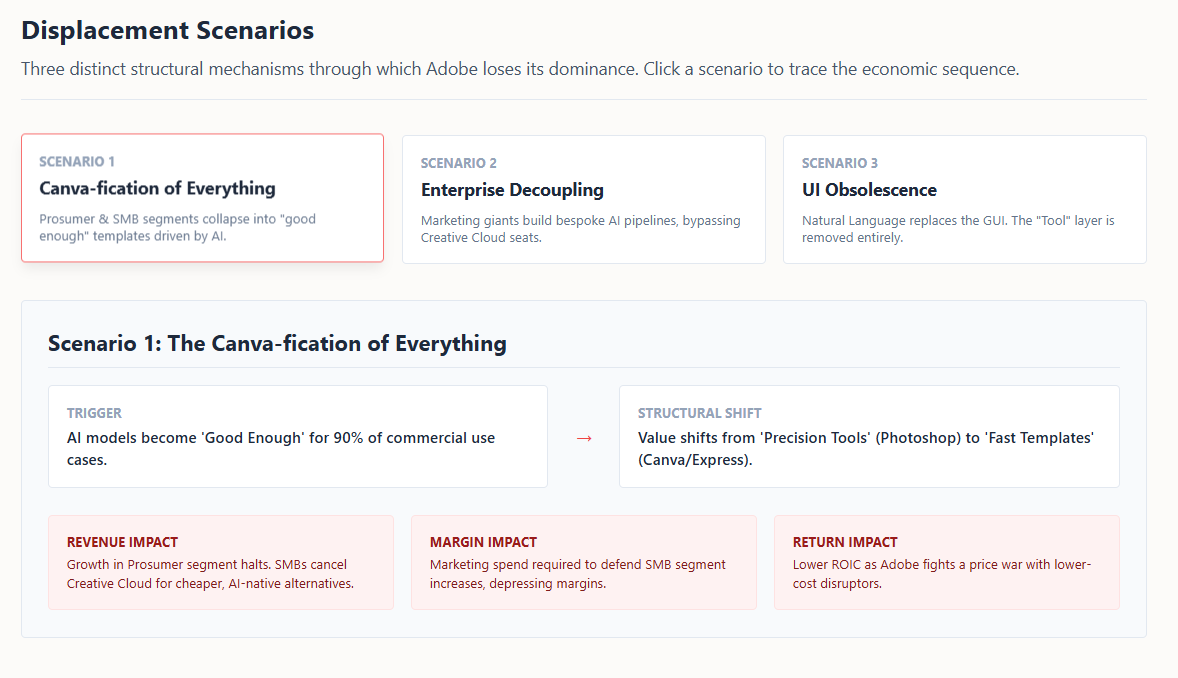
5) DISPLACEMENT SCENARIOS (3 Required)

For each scenario include:

AI trigger

Structural shift

Revenue impact

Margin impact

Long-term return impact

Leading indicator

Probability (Low / Medium / High)

Status: Early evidence visible / Emerging signals / Pure hypothesis

Scenarios must be distinct and non-overlapping.

6) STRUCTURAL REPLACEMENT TEST (Mandatory)

Assess full replacement risk.

Answer clearly:

What function does this company perform today?

If AI removes that function, what replaces it?

Does value shift to:

Infrastructure providers?

Platforms?

AI-native companies?

End users directly?

Describe the new industry structure if this company disappears.

Who captures profits instead?

Does this company have structural access to the new layer?

If replacement is plausible, explain:

Adoption trigger

Behavioral shift

Revenue collapse pathway

Probability estimate

Whether early structural signals are already observable

If unlikely, explain why the function cannot disappear.

7) CAPITAL INTENSITY & RETURN DURABILITY

Assess directionally:

Does AI increase long-term reinvestment needs?

Does it reduce operating leverage?

Does it lower sustainable return on capital?

Does it shorten excess return duration?

Focus on structural direction, not percentages.

8) STRUCTURAL VERDICT

Provide:

One-sentence breakdown thesis

Most exposed moat pillar

Core revenue vulnerability

Primary margin risk

Overall probability of structural impairment

Expected time horizon

Classify:

Margin Compressor

Revenue Durability Collapse

Moat Breakdown

Structural Displacement

Structural Replacement Risk
Here’s an example: Adobe, a stock that fell 41% last year as because of AI risk.
the report start by mapping Adobe’s pre-AI profit engine;
Then test how AI changes the rules through direct and second-order structural impacts.
Finally, the report proposes multiple disruption and replacement scenarios for Adobe’s business model.
Step 2: The AI Edge Test
Now flip the lens.
Step 1 asked: How could AI break this business?
Step 2 asks: How could AI make this business stronger?
Some businesses don’t just survive AI. They become stronger
How?
1. They own something AI needs to work. The business has data, relationships, or access that took years to build. AI turns that into better products, faster decisions, or lower costs. A competitor can copy the AI. They can’t copy what feeds it.
2. Customers were already locked in. AI tightens the lock. People stay because AI made the thing they already use work better for them specifically.
The prompt below tests every way AI could structurally strengthen this business:
Deepen competitive advantage
Strengthen pricing power
Increase switching costs
Improve return on capital
Extend the duration of excess returns
Replace [COMPANY] with your target. Run it in Deep Research mode: