

They put cow tissue inside the human body.
I said that out loud between sets to my wife.
She froze.
“Shhh… she’ll hear you.”
Our 3-year-old is in “I loves animals” periode right now.
I was very close to creating a family disaster.
“Thanks. Now finish your set.”
My wife said.
In last Year, AI transformed my gym sessions to my first filter for discovering new stocks.
But that’s only a step of my process.
In this article, I’ll show you how I use AI to find more stock ideas:
The tools I use at each step
The prompts I use to decide if it deserves deeper work
And the exact process you can add to your own investing research.
The Highest-Leverage Step in Stock Research:
If you only take one AI investing use case from me, make it this one:
Use AI to understand a business fast enough to decide if it deserves a real deep dive
This first filter is where the leverage is.
You don’t need to read the last 3 annual reports just to decide if a stock deserves your time.
well, you can…
But you’ll never see enough businesses to find the real winners.
And on the other side, you can’t just open a screener, look at P/E, revenue growth, and margins… and pretend you understand the business.
You need the basics:
What does this company actually sell?
Who buys and why?
What drives growth?
What’s the competitive edge if there is one?
That used to take a day of reading.
Now AI make that 10X faster ( with the right process)
How my AI first-pass workflow actually works
I already have more stock names than I can realistically analyze.
I keep them in a note app.
Stocks I’ve heard about.
Stocks I’ve seen on X.
Stocks I found in Substack posts, screens, podcasts, or random conversations.
Each step is built to get the most leverage out of AI with the least extra time.
Let me show you how I actually use it.
It happens in 3 steps:
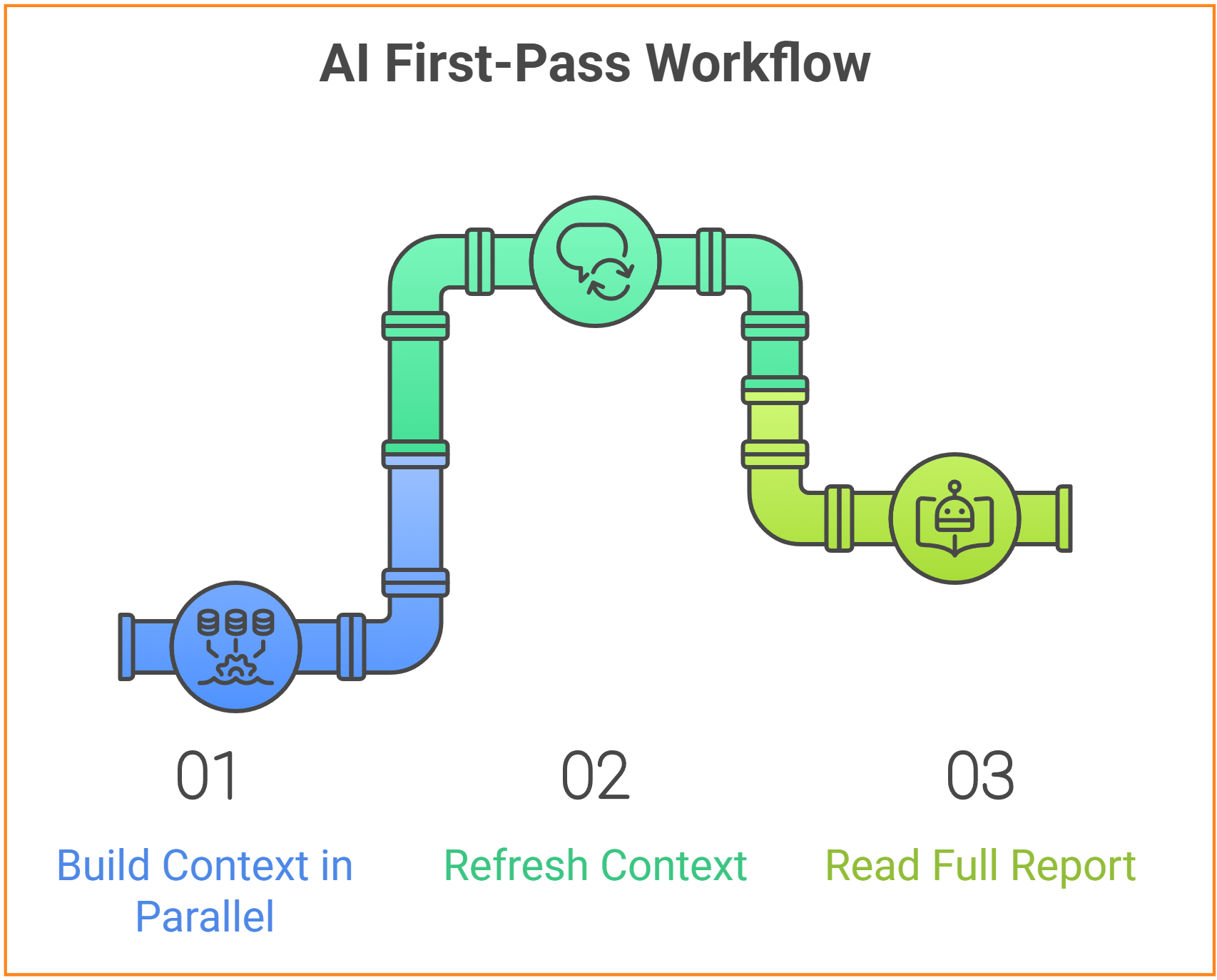
1. Build Context in Parallel
I never start understanding a business at my desk.
If I did, I’d burn too much focused time too early.
So I use the time I already have.
Driving.
Walking.
Training.
That’s where I build the first layer of familiarity with a stock.
So when I finally sit down, I’m not starting cold.
I create an audio podcast from the a selected sources with the prompts I validated.
That way, I hear the business through the lens I actually care about, not generic ESG or macro talk.
During my latest Gym session, I did this with 2 names from my backlog:
LeMaitre Vascular (the “cow tissue inside humans” company)
MIPS (They sell a yellow safety layer inside helmets that prevent brain injury)
By the end of the workout, I already had a rough map of both businesses in my head.
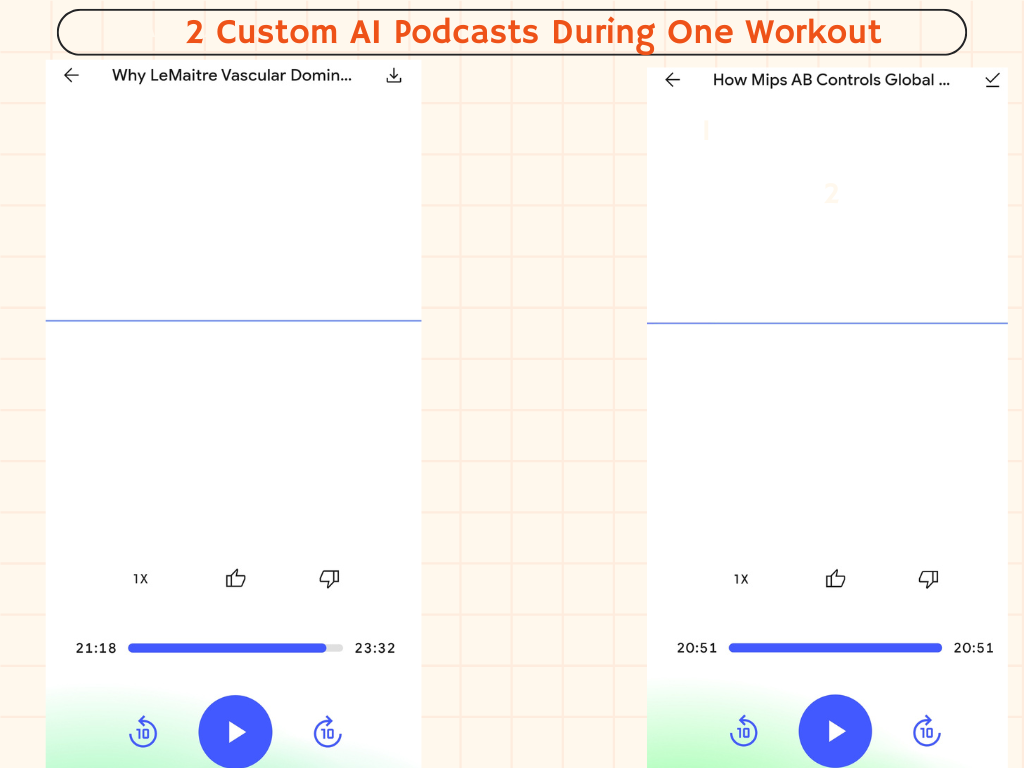
Is this fast ?
Let’s call it 0 extra minutes… and 2 business model snpashot already in my head.
Not bad I think..
2. Refresh the Context
When I go back to my computer.
Now the business is not new anymore.
I’ve already heard the story once.
So I open the 1-pager I already generated.
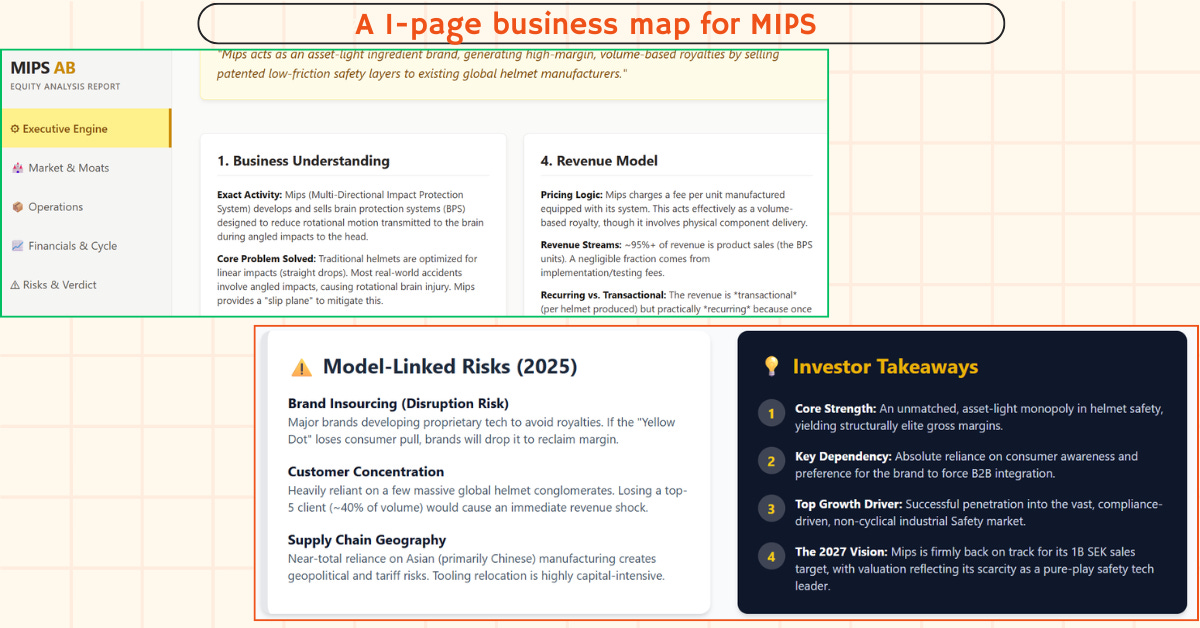
This page gives me the business model in the most optimized format for a first pass.
(I’ll show you how to create it at the end of the article.)
This is not where I discover the business.
I already did that with the podcast earlier.
By the time I sit down, some time has usually passed.
So this is just the quick refresh before I go deeper.
Time spent so far: ~5 minutes at the desk (after 0-minute parallel context building).
3. Read the Full Report
If the stock still looks interesting, I open the full report I already generated with AI that covers the exact points I want to undsertnat in a business.
So I can focus on the real question:
What looks strong.
What looks fragile.
What might deserve a real deep dive.
This usually takes 10 to 12 minutes.
So in total you need only 15 to 20 minutes at my desk, I usually know if a stock deserves deeper work.
Often the answer is no.
That’s still a win.
I learned somthing
I killed a weak idea fast.
And I kept the pipeline moving.
Now let me show you the exact tools and steps to have the same thing.
Note: Don’t read this and say “that’s nice,” and then never try it.
Whether you copy my process or not, you need something like this in your workflow.
Try it for one week, this will transform your investing process.
How to Build This 3-Step Workflow Yourself:
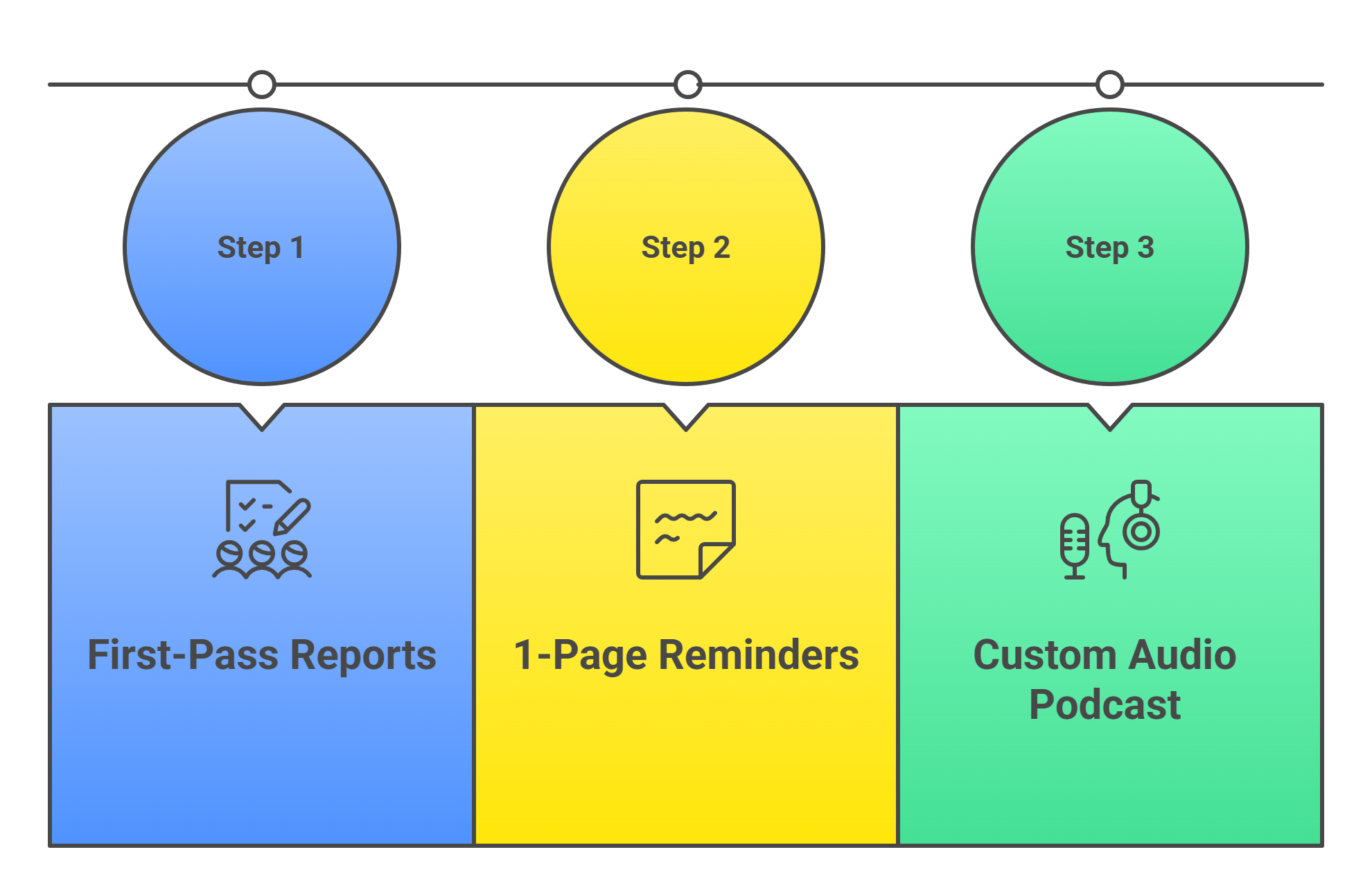
This workflow only needs 2 tools:
Any LLM with Deep Research mode
NotebookLM ( free is ok)
Quick reminder: Deep Research is non-negotiable.
The whole workflow depends on the quality of the reports.
That’s why I use Deep Research, not a normal chat prompt.
It’s the only reliable way to:
build a real research plan
scan hundreds of sources
write the report in the exact format I want
But none of this works without a good, detailed, validated prompt.
I still use Gemini for this step because it still performs best here.
NotebookLM comes in Step 2.