

Hello, fellow stock pickers
Some business models click instantly.
Others make your brain hurt.
Payments sit in that second group , complex, abstract, and full of middlemen.
That’s why most investors skip them.
Recently, a few friends kept mentioning Shift4 Payments but i didn’t look into it.
I have never spent time on the payments industry, so it just felt too messy to start.
But that’s when I realized something:
The hardest part of investing is understanding a new business model in a new industry.
Once you get past that, everything clicks.
You see what matters.
You ask better questions.
And your deep work compounds fast.
The good news is that AI can break that barrier .. but only if you know exactly how to use it.
Here’s the workflow I use to go from “I don’t get this business” to “I could explain it to a friend.”
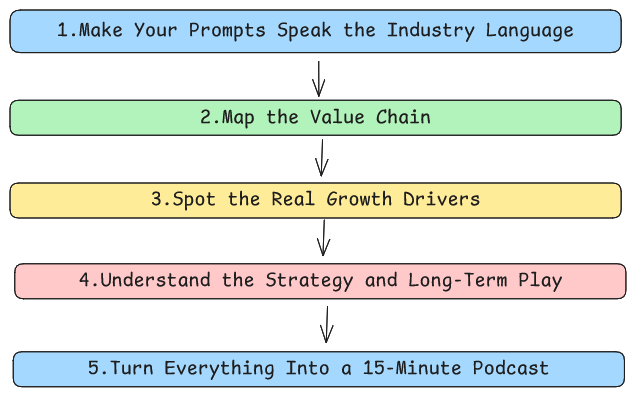
1.Make Your Prompts Speak the Industry Language
Using the right prompt is the whole game.
Let’s be clear:
Saying “analyze this stock like Buffett” doesn’t work.
A good prompt must be:
Specific :clear on the goal.
Structured: built with logic.
Fluent :written in the language of the business.
If you’ve been reading my work, you know I keep a library of master prompts.
They’re often 2 pages long.
That’s the level of detail required to get the most out of AI.
But when I study a complex industry, I take it one step further.
I make the prompt more detailed.
More precise.
More context-aware
Here’s how to do it
1. Pick your master prompt.
A master prompt is a proven template I’ve refined through testing.
It’s generic enough to work across industries and built to be run in DeepSearch mode.
Think of the three prompts I’ll share in steps 2, 3, and 4.
2. Use a “translator” prompt.
This step adapts your master prompt to the specific business you’re studying.
The translator prompt rewrites your original prompt using:
The right jargon (so the AI speaks the industry’s language)
The right logic (so it follows how experts actually reason)
The right mental models (so insights reflect real-world dynamics)
In short, it turns a generic prompt into an industry-fluent one, the kind that pulls deeper, more relevant answers.
3.Run the translator prompt in a ChatGPT “thinking” model.
This step lets the model reason through the industry context before generating the final version.
It doesn’t just swap words it rebuilds the logic of your master prompt using the right tone, structure, and assumptions.
The output is a refined, industry-fluent prompt ready to use.
Use this prompt to adapt Master Prompt to Any Business