

I can tell the difference between an investor who uses AI as a real research tool and one who uses it like a gadget based on one thing:
How specific their questions are when using AI.
That’s it.
You may be thinking:
My questions are already specific.
Let me tell you a secret: they probably aren’t that specific.
Specificity has levels.
And that difference can take AI from random answers to real research.
Why?
Because:
The deeper you go, the fewer decisions you leave to AI.
You decide what to research.
What information matters.
How to analyze it.
And what a useful answer looks like.
This is the principle behind almost every investing prompt and Skill I build.
I call it the 3-Layer Question Framework.
This is what I use to build my prompts and Skills.
A Skill can take me 8–10 hours to build.
But it always starts with this framework.
Let me show you how I use it:
The 3 layers of a great AI question:
Let’s get practical.
Last week, I shared the Financial History Reader Skill.

You can use it to turn 10 years of filings into a clear explanation of how a business evolved, and what actually drove revenue, margins, and cash flow.
It’s a huge research machine.
But underneath, it is built on the same 3-layer structure:
Outcome question: What exactly am I trying to understand?
Sub-questions: What do I need to answer to understand it?
Answer specification: What does a good answer to each question require?
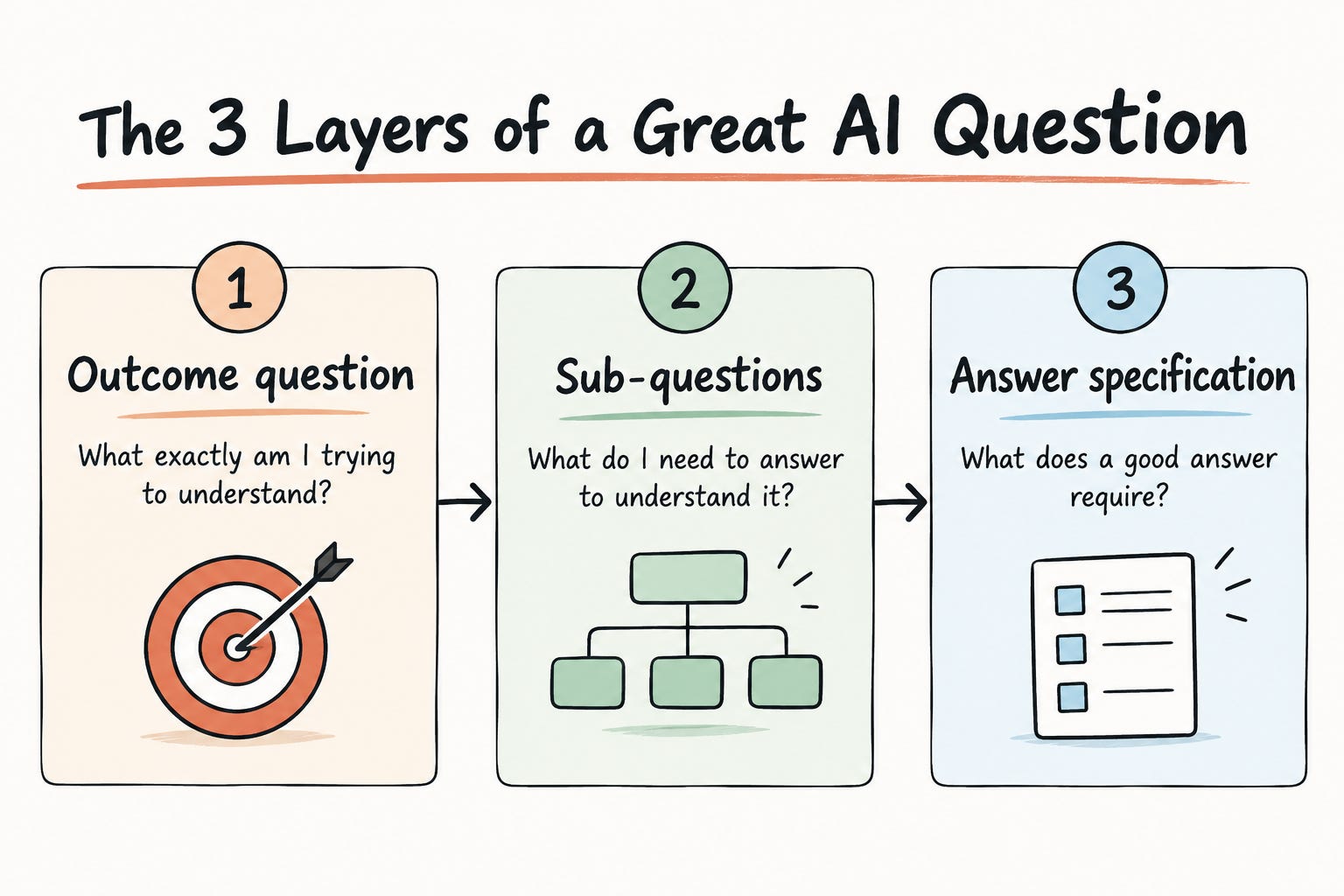
Here’s how to apply this 3-layer framework to any investing research question:
Let’s start with the kind of question most people would ask:
Analyze this company’s last 10 years of financials.
Think about how many decisions you just left to AI.
What should it focus on?
Revenue?
Margins?
Which years matter most?
How should it determine what caused a change?
Should it trust management’s explanation?
What counts as enough evidence?
What should the final report look like?
You asked one question.
But underneath it, there are dozens of decisions AI now has to make for you.
So I start going deeper.
Layer 1: Outcome question
The first question is:
What exactly am I trying to understand?
For the Financial History Reader, the goal was not:
Analyze 10 years of financial statements.
I want to answer something much more precise:
What drove this business’s revenue, margins, and cash flow over the last 10 years, and how did its economics change over time, so I can decide whether it deserves deeper research?
Now the Skill has a job.
Everything it does should help answer that question.
But this outcome question is still far too big to answer directly.
So we go one level deeper.
Layer 2: Sub-questions:
This is where investing experience really comes into play.
Now I ask myself:
What subs questions do I need answered to understand the outcome?
For the Financial History Reader, that means identifying the financial and operating questions needed to explain each year:
Revenue: Was growth driven by price, volume, mix, M&A, FX, or expansion?
Segments: Which segment created the incremental revenue and profit?
Margins: Which cost lines moved, what caused it, was it structural or temporary?
Balance sheet: What do changes in debt, working capital, goodwill, or share count tell me about the business?
Plus a handful of other questions…
But even this still leaves decisions to AI.
That’s where Layer 3 begins.
Layer 3: Answer specification
This is where research discipline comes into play.
Now I ask myself:
What would I require before accepting AI’s answer to each question?
For the Financial History Reader, I define:
Where to look: filings, earnings releases, calls, and structured financial data.
What to check: restatements, changing definitions, and whether the numbers are actually comparable.
What to test: whether management’s explanation is supported by the numbers.
What to distinguish: reported facts, calculations, and AI inference.
What business data to use: price, volume, customers, units, utilisation, or whatever actually explains the financial change.
How I want the report: short year-by-year cards, more detail only on important years, then the few mechanisms that explain the decade.
This is how you turn AI from guessing what to do into following a clear research process step by step.
Final thoughts
I know that this takes time…
But the more clearly you define it beforehand, the less AI has to guess, and the better the research gets.
See you next week,
Mostapha
P.S. If you don’t want to build all of this yourself, paid members get access to my ready-to-use investing Skills, including the Financial History Reader.