

“Mohnish Pabrai is a scam.”
My friend was dead serious !
I laughed.
No bro… even if he drops the “I was friends with Munger” line 10x per sentence.. he’s a legit investor.
Yes that’s the problem, my freind said:
“He talks like Munger and then buys Metallurgical coal stocks and offshore drillers.”
I laughed.
But I knew exactly what he meant.
My friend analyzes every stock like it should be a compounder.
His bear case is often:
“ROIC is only 15%… pass.”
But every investment thesis is different.
And different investments fail differently.
A turnaround breaks when the business never turns.
A compounder breaks when quality fades or you paid too much.
A cyclical bear case is when peak earnings get mistaken for normal earnings.
What really matters is pattern recognition.
The kind that usually takes years in the market.
Years of reading filings.
Years of watching how stories break.
Years of learning what actually kills returns.
Unless…
Now we have a machine that can compress years of pattern recognition into minutes.
Yes, that’s AI.
In this article, I’ll show you how to use Claude to challange any stock thesis, find the hidden weak points, and generate a bear case report.
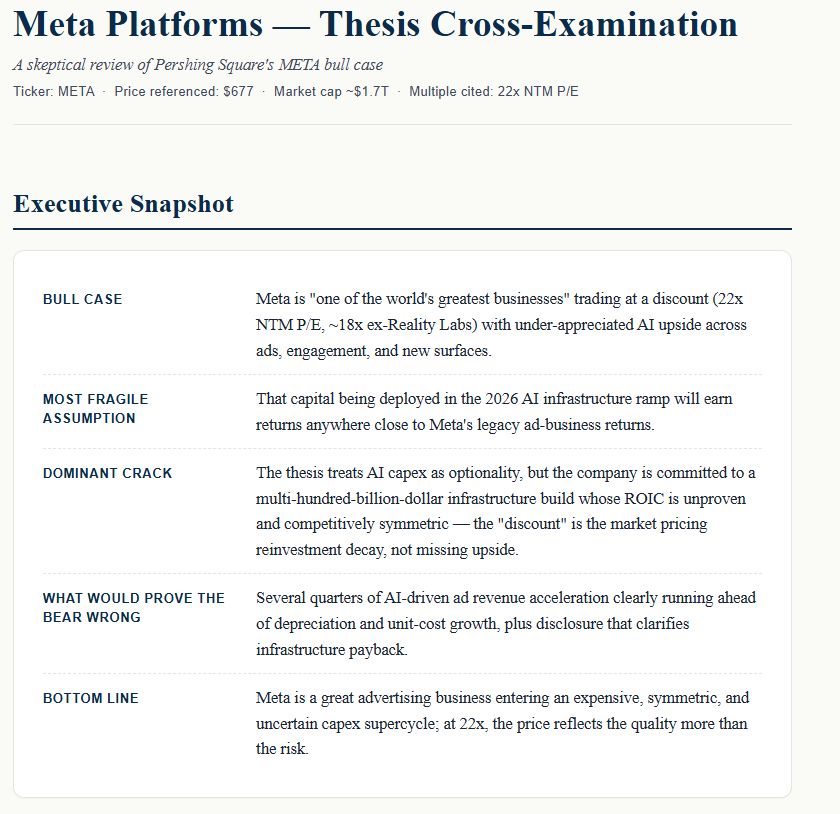
By the end of this article, you’ll be able to:
download a file
upload it into Claude
run it anytime you want to stress-test a thesis
But I don’t want you to use it like a black box.
Before you trust the output, you should understand the system behind it.
So let’s break down:
How this agent actually works
Why it thinks like an investor, not like a random AI prompt from the internet
The Real Cost of Borrowed Conviction:
Reading a great bull case is dangerous.
Because it can make you believe a thesis before you’ve done the work.
You read a strong write-up from your favorite investor.
And before you know the stock, you’re already seeing it through their lens.
That’s the big trap.
Now, Imaine this:
You read a bull case.
One click later, you get the counter-case.
Not a generic risk list.
A real attempt to break the thesis:
where it’s weak
what has to go right
what could break it, and why
So before you believe the story…
you can test it.
The 4-Layer Thesis Breaker for Claude
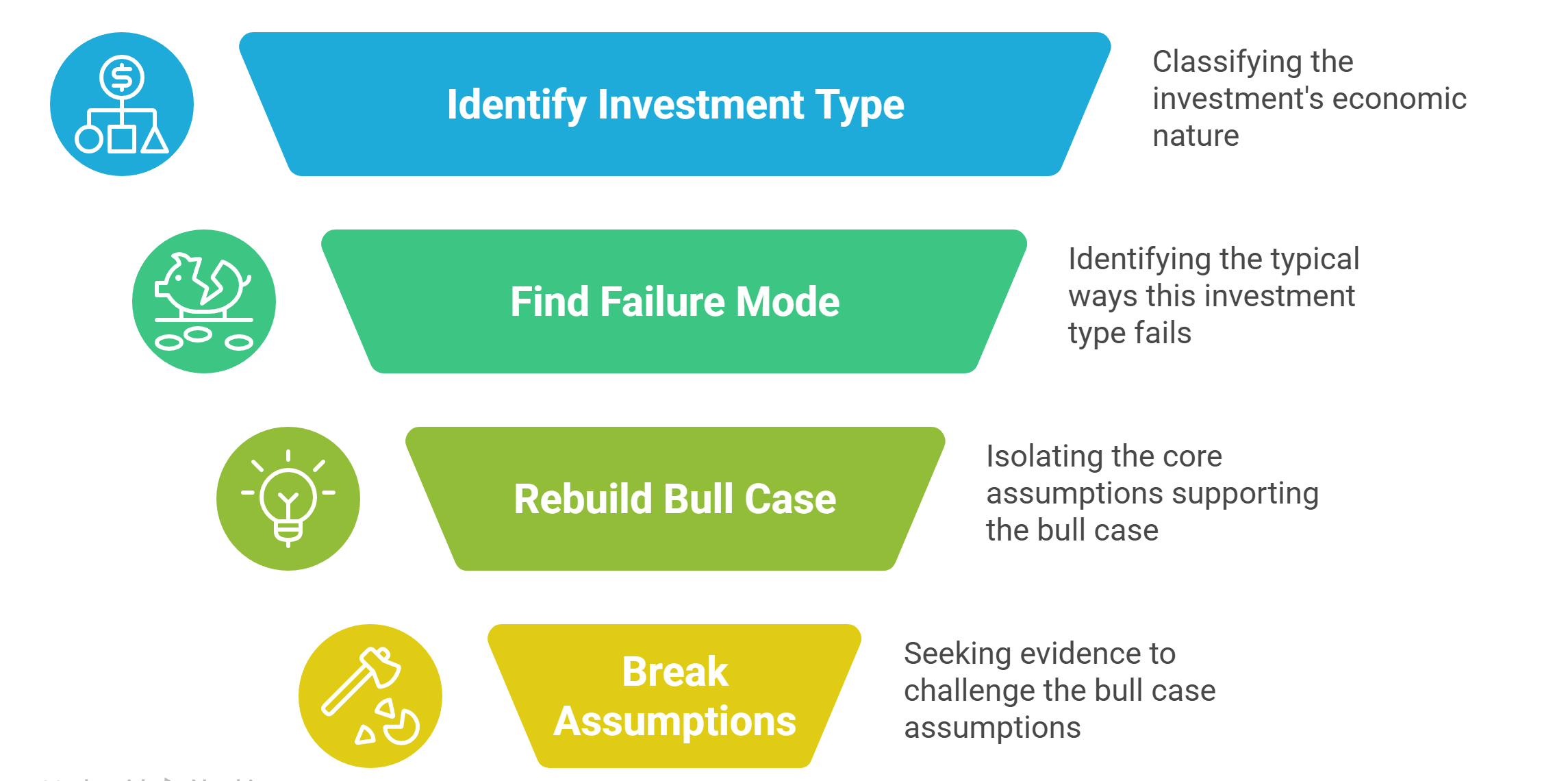
The full workflow is built inside Claude.
You give it a stock thesis.
Claude runs the process the same way every time.
Layer 1: What kind of bet is this really?
Layer 2: How does this type of stock usually break?
Layer 3: What does the thesis really depend on?
Layer 4: What does the evidence say?
That works because the system lives inside a Claude Skill.
Reminder:
A Claude Skill is a reusable workflow you can install inside Claude.
Under the hood, it is a packaged set of instructions, prompts, and reference files that tell Claude what to do, in what order, and how to format the output.
This is where I store the investing logic behind the system.
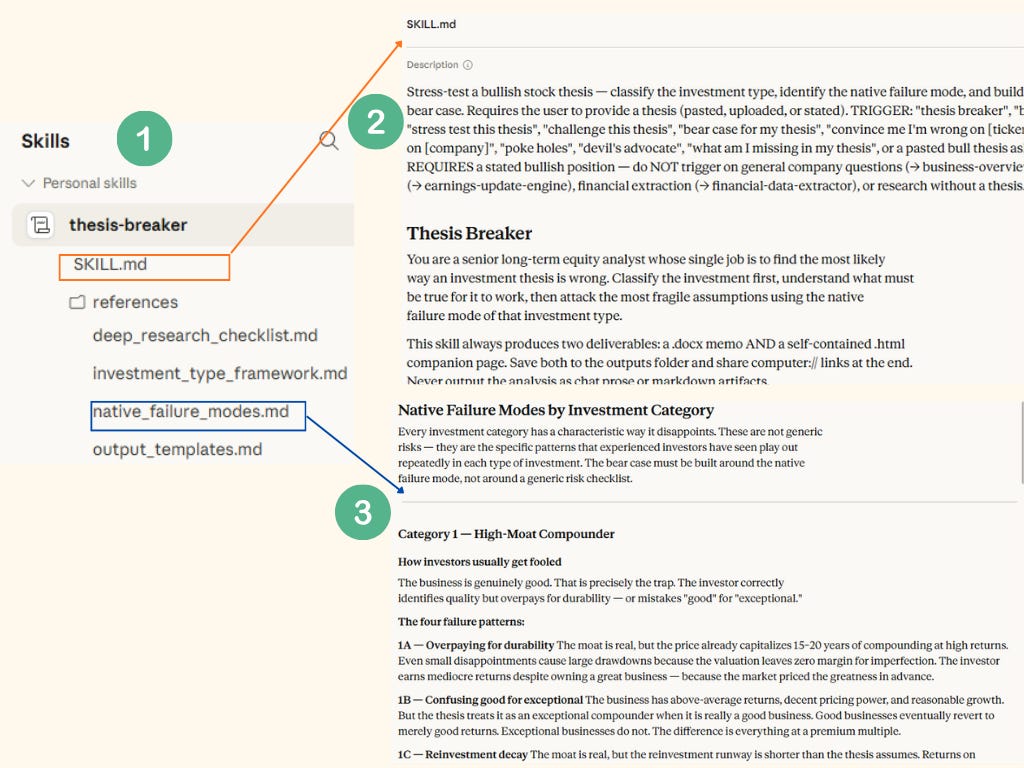
At the top is one main file: SKILL.md
Think of this as the control center.
It tells Claude:
what output to produce
what steps to run
what order to follow
and which files to load next
Then Claude opens the references folder.
This is where the investing logic, failure patterns, and research instructions are stored.
Let’s run this system together:
Here is how it works in practice:
Install Claude Desktop (Cowork) on your computer
Turn on Extended Thinking
Use Opus 4.6
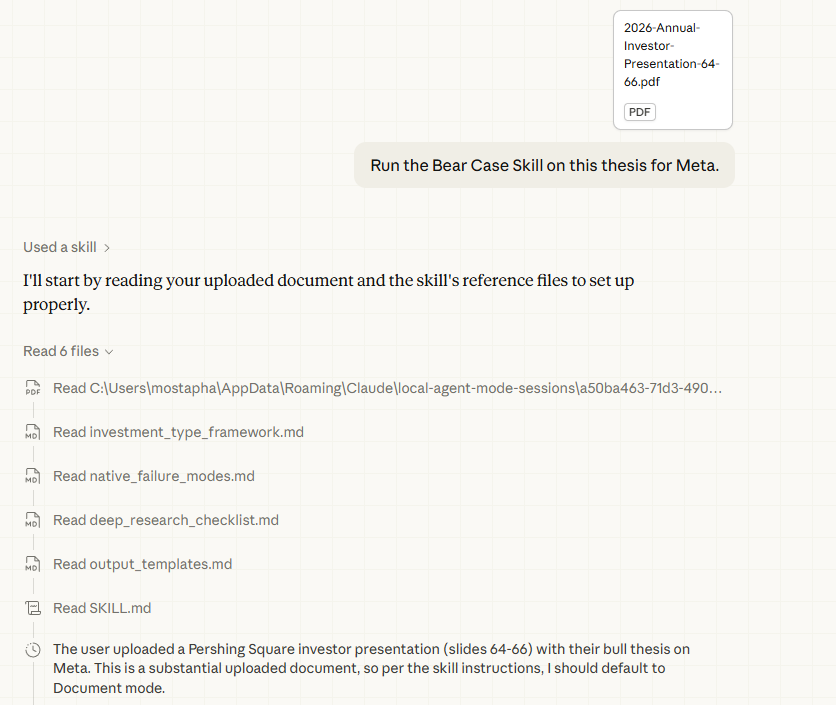
Upload the thesis file:
For example I’m using the Pershing Square Meta deck
Trigger the skill
Type: Run the Thesis Breaker Skill on this thesis
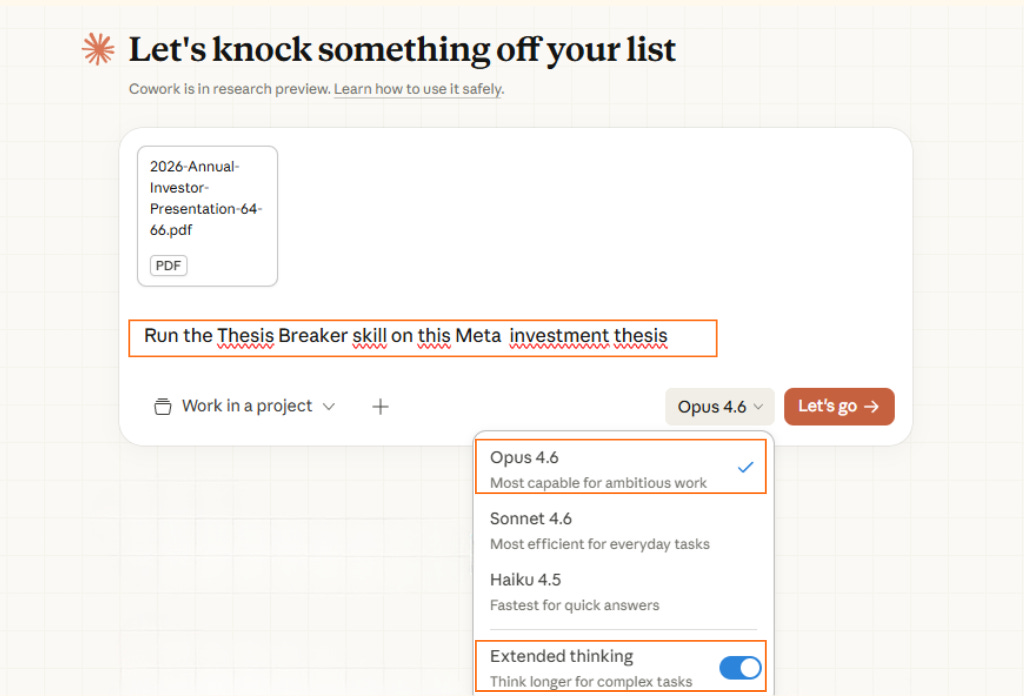
Now let’s break down what it is actually doing.
Step 1: Identify the Investment Type
The first layer figures out what kind of investment this really is.
This matters more than most investors think.
Because if you frame the stock the wrong way, you build the wrong bear case.
This layer classifies the thesis as a:
growth story
turnaround
cyclical
serial acquirer
asset play
regulated / quasi-monopoly
or a hybrid
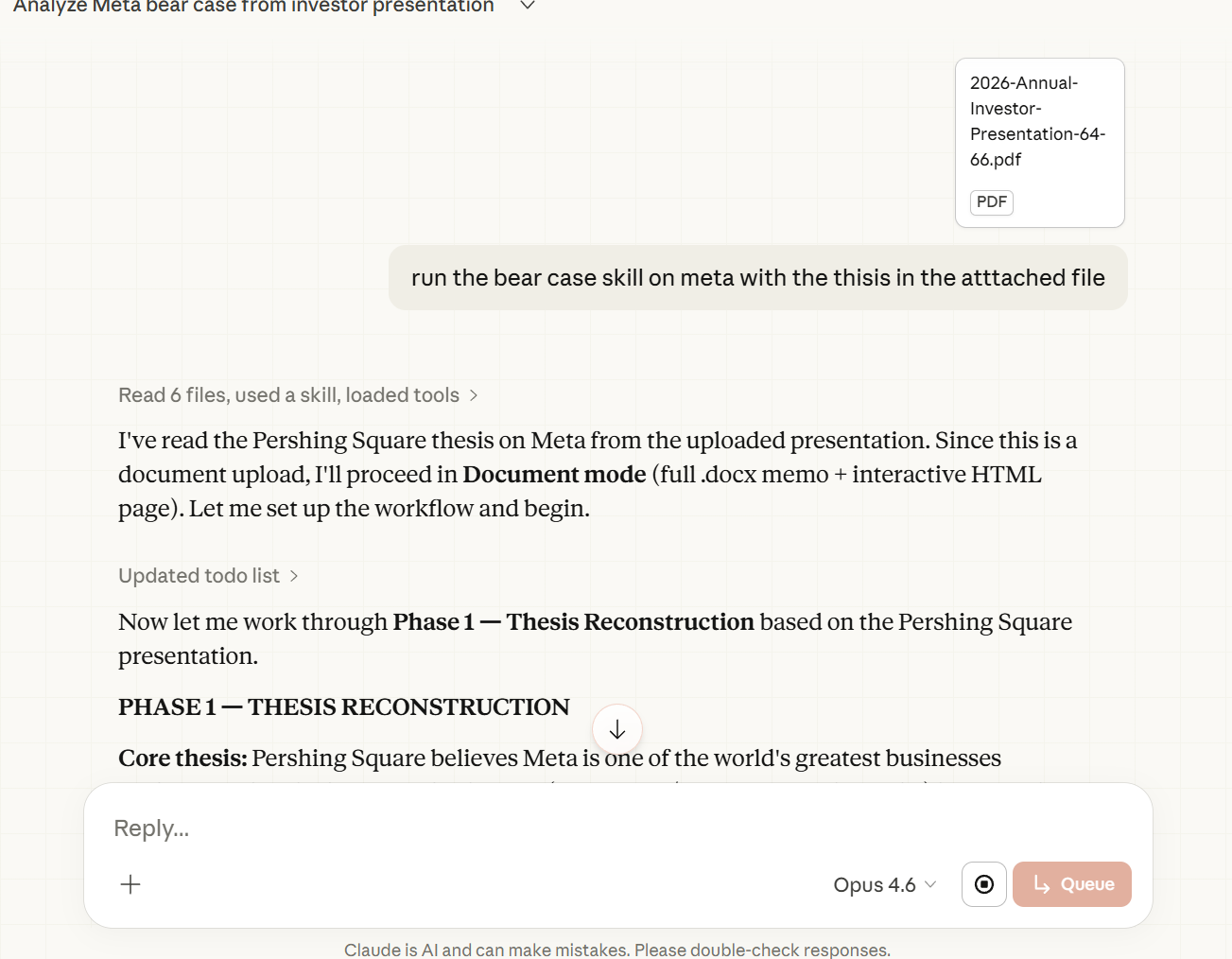
Step 2: Find the Failure Mode
Once the system knows what kind of bet this is, it asks the right question:
Why does this type of investment usually fail?
For example:
a great business bought at a terrible price
growth that never becomes real economics
a turnaround that is really structural decline
peak margins mistaken for durable quality
acquisition optics hiding weak returns
Claude uses my instructions to find the most likely way this specific thesis breaks.
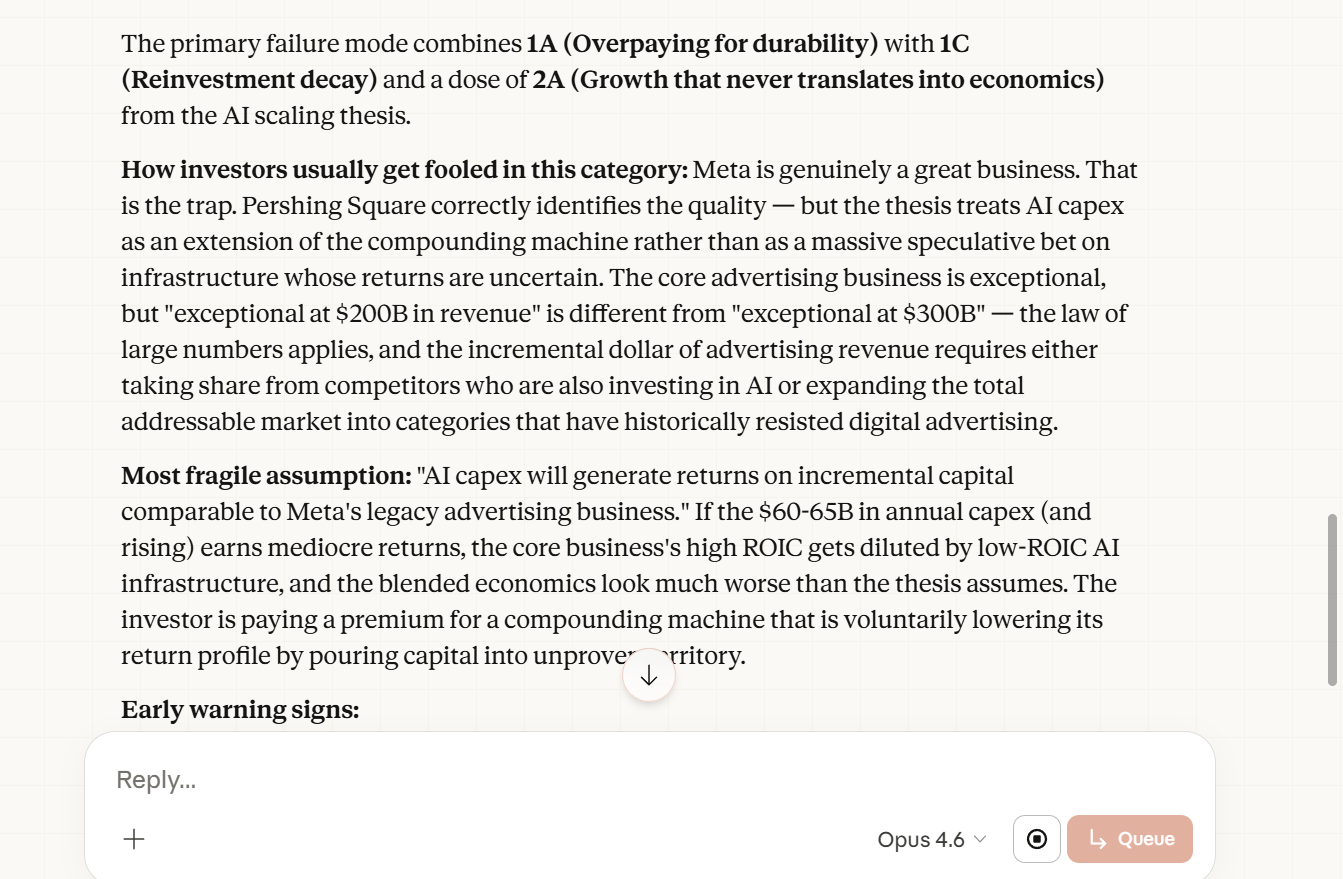
Step 3: Rebuild the Bull Case
Before you can break a thesis, you need to know what the bull is actually betting on.
That is what this layer does.
It rebuilds the bull case from the real source material.
Then it strips the story down to the few assumptions that actually matter:
growth stays strong
margins keep improving
returns on capital stay high
the moat holds
capital allocation stays smart
the valuation still makes sense
This is critical.
Because most bull cases sound complex.
But most of them only depend on a few key beliefs.
And if one breaks, the whole thesis changes.
Step 4: Break the Assumptions
Now the system goes looking for evidence against those key beliefs.
Claude uses Deep Research to pull in more information from 50+ sources.
It starts with the official documents and trusted sources I validated in the skill reference files.
Then it turns all of that into one final output:
what the bull is really betting on
where the thesis is weakest
what could break it
what would prove the bear wrong
and what to watch next
The Result
Once the skill finishes, you get 2 outputs:
an interactive web page to explore the thesis
a structured 8 pages bear-case report
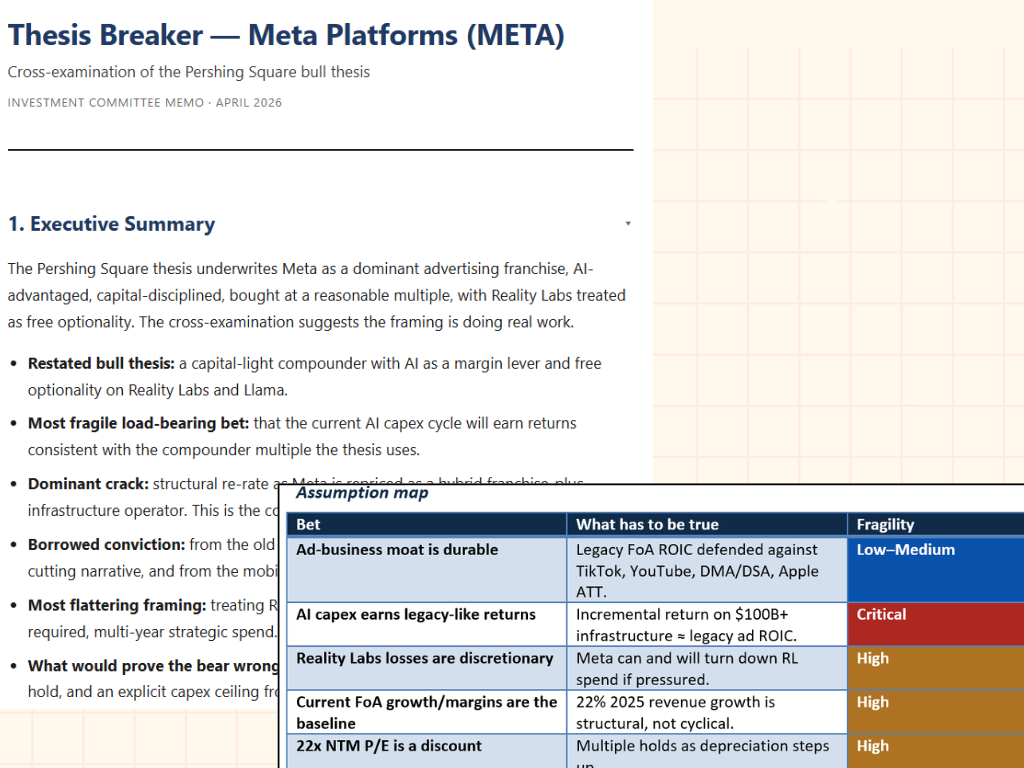
Install the Skill
Download the file attached below: